 industrial-springs.com



















Extension springs
Extension springs in piano wire, electrogalvanised wire and stainless steel wire
NEW RANGE - We have a large quantity of extension springs in AISI 316 material in stock!
If you need to use springs in salt water or in connection with strong cleaning agents, then choose Stainless 316 and see our selection of acid-resistant stainless extension springs.
Order Monday-Thursday before 15:30 and Friday before 14:45 and we’ll dispatch your order the same day with expected delivery within 2-10 days. This applies to all stocked extension springs
See quantity discounts and prices by clicking on the shopping cart next to the required product.
With the help of our sorting sliders, we have made it easy and quick to navigate around our range of standard extension springs in more than 3,000 different sizes.
We have everything from small extension springs to large extension springs for use everywhere in industry as well as privately. The range of standard extension springs are offered in lengths from 6.35mm to 377.00mm (unloaded length). The selection is produced in accordance with current DIN standards with the highest quality demands in Europe and America.
An extension spring is used where traction is needed. This could, for instance, be in industrial and agricultural machinery. Large and small constructions.
An extension spring accumulates a force when the spring is pulled apart. The further you stretch it, the more force is accumulated. The force is released again when the spring is allowed to return to its original length. If an extension spring is used and dimensioned correctly, it can be used for a very long time. See further information under 'Lifetime' in technical information below.
Piano wire springs are recommended for use in dry environments. The material offers no protection against rust. The strength of piano wire springs is approx. 10% stronger than stainless wire springs.
Electrogalvanized extension springs are made from piano wire, which is then electrogalvanized. This gives the extension springs a nice shiny surface. The electro-galvanization provides only moderate corrosion resistance, but if the spring is used in a humid environment, the service life will be extended compared to the same spring in piano wire without surface treatment.
For humid environments we recommend springs made from stainless steel wire. The strength of stainless extension springs is approx. 10% weaker than on piano wire springs. If you use springs in environments where they are exposed to harsh chemicals or salt water, we recommend springs in a specific type of stainless steel (AISI 316).
If you are unsure about the length/travel you need, we have springs in lengths of 300, 500 and 1,000 mm manufactured specifically to be cut to length and used for prototypes and testing. Sort by lengths using the slider below. Sort by lengths using the slider below.
Note: These springs do not have loops. They must be bent up by the customer, following cutting to the desired length, if necessary. To extend the service life, we recommend that the bends are made as soft bends, not sharp bends or notches.
The wire is certified in accordance with DIN 17223 Class C Wire WERKSTOFF NO. 1.1200 – EN Norm 10270-1
Working temperature between -30 ºC and +120 ºC
Recommended for use in dry environments.
The wire is certified in accordance with DIN 17224 AISI 302 WERKSTOFF NO. 1.4310 – EN Norm 10270-3
Working temperature between -200 ºC and +250 ºC
Can be used in dry and humid or wet environments.
The wire is certified in accordance with DIN 17224 AISI 316 WERKSTOFF NO. 1.4401 – EN Norm 10270-3
Working temperature between -200 ºC and +250 ºC
Can be used in dry and humid or wet environments. Used in constructions that are exposed to harsh cleaning agents or in maritime environments
The wire is certified in accordance with DIN 17223 Class C Wire WERKSTOFF NO. 1.1200 – EN Norm 10270-1
Working temperature between -30 ºC and +120 ºC
Galvanised extension springs are made from piano wire, which is then electrogalvanised. Electrogalvanisation means that the extension spring is given a shiny, more corrosion-resistant surface.
Recommended for use in dry environments.
Series A and C: (See which series a spring belongs to in the “Series” column in the table).
All dimensions and forces in accordance with DIN 2097 (Grade 2). DIN 2097 defines the force as the determining parameter. The number of coils may therefore vary and will consequently not be stated for these series.
Series B: (See which series a spring belongs to in the “Series” column in the table).
The outside diameter and length are defined according to the following tables
Series D: (See which series a spring belongs to in the “Series” column in the table).
The series is produced for use in testing and prototyping. There are therefore no tolerances for this series.
As this series is designed for testing, the cut spring’s coils will vary from spring to spring, and so the spring constant cannot be defined.
If you want a PDF datasheet or a 3D CAD drawing of the spring in .step, .iges or .sat format, these can be downloaded for free by clicking on the 3D CAD symbol next to the item number in the table.
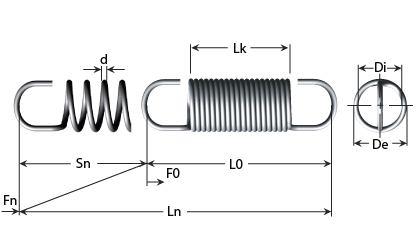
The max. force in Newtons (Fn) for an extension spring in certified piano wire is approx. 10% higher than for the same dimensions in stainless spring steel.
Calculating initial tension (F0):
The initial tension (F0) of an extension spring is also called the initial force. This indicates how much force will be used to activate the extension spring.
Initial tension (F0) or initial force is for guidance only, as it can vary from batch to batch. As a rule of thumb, you can say that the initial tension (F0) corresponds to approx. 10-15% of maximum force (Fn).
Initial tension (F0) = Maximum force (Fn) - (Spring constant (R) x Maximum travel (Sn))
For example, the initial tension for stock number 32600 (Fn = 237 N, R = 2.67 N/mm and Sn = 75.70 mm) is calculated as:
237 N - (2,67 N/mm * 75,70 mm) = 35 N
The calculation of spring force at a given length:
If you want to know how much force an extension spring produces at a given length/travel, you can use the following formula:
Force at a given length (F1) = Initial tension (F0) + (Maximum travel (Sn) * Spring constant (R))
For example, stock number 32600, where R = 2.67 N/mm, where we want to know the force for a travel of 55 mm and F0 is approx. 35 N.
35 N + (55 mm * 2,67 N/mm) = 182 N
Series A: (See which series a spring belongs to in the “Series” column in the table).
German loops as per DIN 2097, random angle.
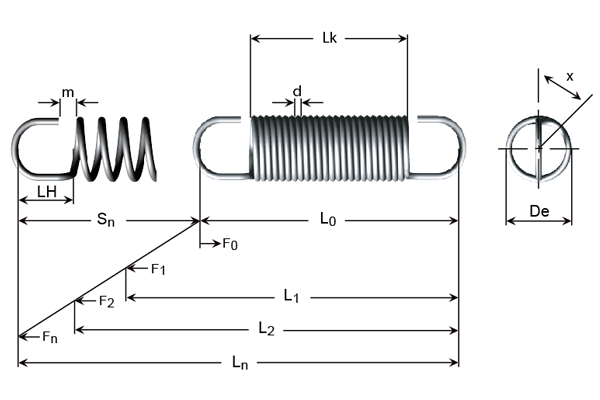
The loop position (X) is variable and the loops can therefore be turned in relation to one another. The external diameter of loops may well exceed the external diameter of the body.
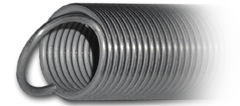
German loop
Series A: Tolerance of loop width
The tolerance for deviations of loop width is determined based on the formula below. Note that you must use a value determined based on the spring’s coil ratio to be able to calculate the tolerance.
De (external diameter) + value from coil ratio table
Example: Stock number 32600 has a wire thickness (d) of 2.5 mm. The external diameter (De) is 18 mm, which produces a mean diameter (Dm) of 15.5 mm.
Based on the coil ratio table, we can therefore arrive at the value that needs to be added to the spring’s external diameter (De) to find the max. external diameter of the loop.
Coil ratio: 15,5 mm / 2,5 mm = 6,2 mm
Loop max. width: 18 mm + (1,5 * 2,5 mm) = 21,75 mm
Series A: - Tolerance of internal loop height
The tolerance of internal loop height (LH) is from 0.8 to 1.1 * Di.
E.g. Stock number 32600 has a internal diameter (Di) of 13.0 mm.:
Min. internal loop height = 0,8 * 13,0 mm = 10,4 mm.
Max. internal loop height = 1,1 * 13,0 mm = 14,3 mm.
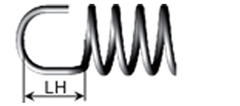
Loop height (LH)
Series B and C: (See which series a spring belongs to in the “Series” column in the table).
Loops in this range are German loops without a specific loop shape and with a random angle. Exceptions are stock numbers 503 and 503RF, which have English loops.
Every effort is made to keep the same external diameter for the loop as the spring body. However, the external diameter of the loop may vary. There are no tolerances for this series.
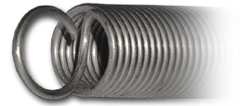
English loop
Series D: (See which series a spring belongs to in the “Series” column in the table).
There are no loops for this series. It is intended for testing and cutting. The customer must, therefore, create their own loops. To extend the service life of the spring, we recommend making loops in soft bends without notches. If the loop is bent too sharply, this may result in a weak point in the spring.
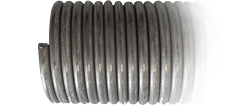
Series D does not have loops
The service life of a spring is generally very difficult to define. A large number of parameters come into play, and it is therefore impossible to define a service life.
Parameters with a significant influence on service life include: Installation, installation method, number of movements, vibrations, shocks, torsion, length of travel, non-axial travel, temperature, wear against other surfaces, environment of use, any cleaning agents, lateral impacts, etc.
Always dimension an extension spring so that it delivers the desired travel and force with as little exertion as possible. This will give the spring the longest possible service life.
Applying the maximum load to the spring or exceeding it will shorten its service life and may cause it to become permanently distorted.
Therefore we recommend that you do not use more than 75% of the maximum travel (Sn) of conical springs.
Usually right. The force and application is not affected by the direction of wind.
Standard extension springs are not defined with a specific direction of wind. Depending on production, the springs may be either right or left wound.
If an extension spring with an exact value for one of the following parameters is required, springs must be custom-made:
- Loop type
- Loop height (LH)
- Loop position (X)
- Loop width (if the spring is to be incorporated into a tube)
- Opening at loop (m)
- Initial force (F0)
When using springs for baby hammocks or baby bouncers, for instance, or other structures where a person is suspended from a structure in some way, you must be aware of the following:
Spring deformities or breakages
A spring is a technical object that can be deformed, or that may break during use. There may be invisible defects in the alloy of a spring wire, and during the manufacture of the spring defects may also occur that can weaken the spring. Improper use of a spring can also reduce the service life of a spring and result in the spring becoming deformed or breaking.
A spring must always be dimensioned so that the spring always incorporates a safety factor that corresponds to the risk in use.
Safety device – IMPORTANT!
If a spring is to be used in a structure where a person is suspended in some way from the structure, and the spring will be a load-bearing element between the person and the structure, a separate appropriate safety device must be installed between the person and a fixed point. This ensures that the person cannot fall down if the spring becomes deformed or breaks.
It is always the user of a spring – in any structure where persons can fall or otherwise injure themselves – who is responsible for ensuring that the structure is correctly designed so that no personal injury can result if a spring becomes deformed or breaks.
Sodemann Industrifjedre A/S DOES NOT recommend the use of springs in structures where people are suspended from the spring.
Internet Explorer Incompatibility
This website unfortunately does not work well with Internet Explorer. We recommend using one of the following free browsers: